

I’ve been seeing a social media trend lately questioning the why diesel prices (and gasoline) are so elevated and making comparisons to 2008: “oil was $147 in 2008 and diesel peaked under $5. Oil is $95 now, so how is diesel $6.50?” It’s a question worth understanding, because diesel is the fuel that moves nearly everything you buy- from trucks to tractors, trains and beyond.
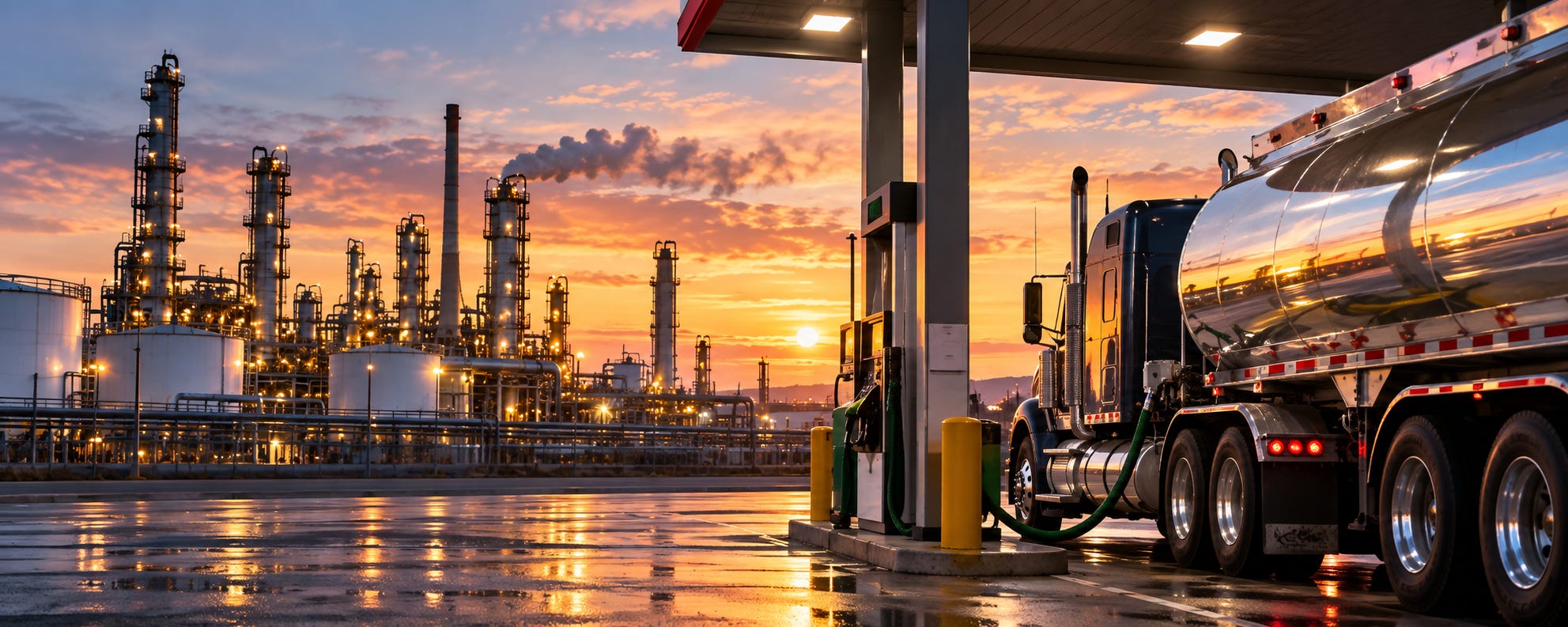
A barrel of oil holds 42 gallons. At $95 a barrel, the crude oil in each gallon costs about $2.26. Diesel at $6.50/gal means more than $4 of every gallon has nothing to do with the price of oil. Taxes account for some of it, roughly 60 cents between federal and average state levies. The rest comes down to one thing: how hard it is right now to turn oil into diesel, and how many people around the world are fighting over getting it.
Here’s the easiest way I’ve found to explain it. Think of a barrel of oil like a steer. One steer gives you a lot of ground beef, but only so much brisket. If everyone suddenly wants brisket, brisket prices soar, even though cattle prices haven’t moved and ground beef is sitting in the cooler at a normal price. A barrel of oil works in basically the same way. Refineries get more gasoline out of each barrel than diesel. Roughly 45% of a barrel of oil is turned into gasoline, but only about 25% turns into diesel. So when the world is short diesel specifically, refiners can’t just crank out more of it. Diesel prices climb on their own, while gasoline and crude oil lag behind.
And the world is very tight on diesel right now. Russia normally supplies about one in nine barrels of diesel traded globally. After repeated attacks on its refineries, Russia banned diesel exports completely starting this past July. They’ve continued to extend it every month as continued hits on refineries have led to outages and downtime at their refineries. As a result, that extra diesel supply is simply gone.
Some of the world’s largest and newest export refineries sit in the Persian Gulf, and their diesel has to pass through the Strait of Hormuz. With flows restricted, those gallons are stuck too. China, normally a major fuel exporter in Asia, and the only country with more refining capacity than the U.S., told its refiners to stop exporting earlier this year and is only now slowly reopening the tap. All the potential normal relief valves are stuck closed or mostly shut. That’s why diesel has spiked significantly. Lose that much diesel at once and buyers everywhere go looking for a new source. Increasingly, that source is the USA.
U.S. diesel exports hit an all-time record this summer, close to 1.9 million barrels a day. Buyers in Europe, Latin America and Turkey are paying enough to cover shipping across an ocean, desperate to secure supply. The result: U.S. distillate inventories fell to their lowest seasonal level since 1996. That’s not a local problem you can blame on the station down the street. It’s a global bidding war, and the Gulf Coast is at the center of it.
Diesel has another quality that makes shortages sting- people can’t easily use less of it. You can skip a road trip, but a truck hauling groceries still has to make its delivery. A farmer still has a field that needs tending to. Deliveries and pickups of goods produced at factories can’t just sit. This is what we call inelastic demand- when supply tightens and buyers can’t cut back, the price has to rise a lot to bring things back into balance. Gasoline demand bends a bit- consumers are price sensitive, but diesel demand mostly doesn’t.
Fall is diesel’s busy season. Harvest is starting to get underway, freight picks up ahead of the holidays, and heating oil, which is essentially the same product as diesel, is seeing people across the Northeast fill their heating oil tanks ahead of the winter. On the gasoline side, summer-blend gasoline requirements ended September 15, which may give gasoline a bit of relief this fall- though it may not pull prices down, it’s keeping them more in check. Diesel doesn’t get that break.
So Why Was 2008 Different?
Back in 2008, it wasn’t refined products, it was oil itself that was the bottleneck. Refineries had plenty of capacity and the global economy was sliding into a slowdown, so demand for refined products was weakening. Today, we’re seeing quite the opposite: there’s no shortage of crude oil, it’s just harder to get it to the market, but even a trickle flow is getting through the Strait. Oil prices under $100 tell you that it’s not a doomsday scenario- at least yet. There’s a shortage of diesel and the capacity to make and move it. And adjusted for inflation, $147 oil in 2008 would be well over $200 today.
Refiners are earning significant margins on diesel right now, and I understand why many are questioning that. Those margins are the market’s way of pulling every possible gallon out of every running refinery and pulling in imports wherever they can be found. This summer is seeing U.S. refineries operate at some of their highest levels *this century*. Some regions of the U.S. have seen refinery utilization (a measure of how much of their capacity they’re using) over 100% for several weeks on end. Refineries don’t get to set margins or their profit level- the global market does that via the balance of how much supply is being produced vs. how much global demand there is.
That’s part of the reason that the U.S. has seen such a decline in the number of refineries in the past few decades. We’ve lost 24 refineries so far since the turn of the century mostly because refining has been a very boom/bust cycle, and it’s nearly impossible to predict long-term. This is economics, which pushes prices higher to avoid an actual shortage- the rising prices tell us something(s) are very broken, and that’s why you’re here reading this article. A lot is going wrong, but at the end of the day, rising prices prevent all out shortages from occurring.
If you found this article helpful, please consider sharing it, thank you!
Thanks for the insight.