

Oil prices surged over the past week, climbing to roughly $107 per barrel (7:30pm ET) after touching as high as $110 as escalating tensions involving Iran and continued military activity in the Middle East injected a significant geopolitical risk premium into energy markets. Traders are increasingly concerned about the possibility of supply disruptions in the region, particularly involving shipping through the Strait of Hormuz, a critical chokepoint through which roughly a fifth of the world’s oil supply moves. While oil markets have been volatile for months, the developments over the past several days — including escalating attacks and retaliatory strikes — have rapidly shifted sentiment and forced traders to price in the possibility of a wider conflict. Unfortunately, little positive news emerged over the weekend, meaning when energy markets fully reopen Monday, the sharp rise in oil prices is likely to quickly translate into higher wholesale fuel prices across the U.S.
Gas Prices Have Already Jumped
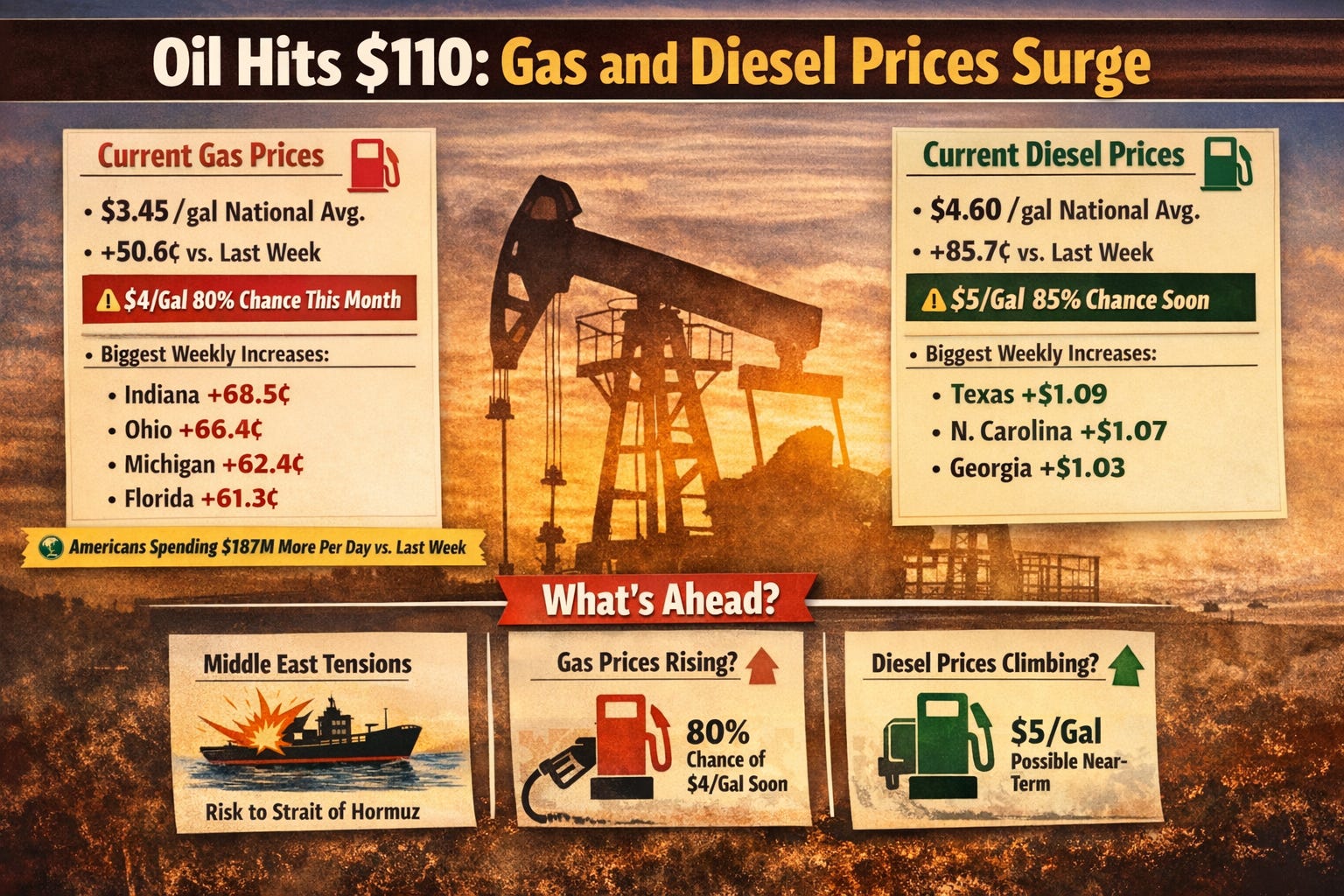
The national average price of gasoline now stands at $3.447 per gallon as of Sunday evening, down 1.5 cents from yesterday but up 50.6 cents from a week ago and 60 cents from a month ago, reflecting the sharp rise in oil prices. Some states, including price cycling markets in the Great Lakes region, have already seen particularly large increases over the past week, led by Indiana (+68.5¢), Ohio (+66.4¢), Michigan (+62.4¢), Florida (+61.3¢), Colorado (+58.4¢), Texas (+57.3¢), New Mexico (+55.7¢), West Virginia (+55.5¢), Iowa (+55.2¢), and California (+54.9¢). These rapid increases highlight how quickly rising crude oil costs can ripple through the gasoline supply chain.
A Second Wave of Price Increases Is Likely
Despite the large jump already seen, gasoline prices are likely to rise further this week. Because oil is surging again in Sunday evening electronic trading, wholesalers and refiners may implement rare “intra-day” price increases at fuel terminals starting Monday morning as they move to pass along the higher cost of crude oil. This could trigger a second wave of gasoline price increases, particularly in states that use price cycling systems such as Michigan, Indiana, Ohio, Illinois, Kentucky, Texas, Florida, Colorado, North Carolina, and South Carolina. In these markets, prices often jump sharply once per week before gradually declining. With oil now much higher, the next cycle could push prices another 20–40 cents above the previous cycle level. For example, areas that last cycled to around $3.59 per gallon could jump to $3.79–$3.99, while markets that cycled near $3.69 could move toward $3.89–$4.09. In non-cycling markets, increases will likely occur more gradually, with stations raising prices 5–15 cents Monday, another 5–15 cents Tuesday, and potentially another 5–15 cents Wednesday before increases begin to slow later in the week.
Where Prices Could Go Next
Given Sunday evening’s data and the continued surge in oil prices, I believe there is roughly an 80% chance the national average price of gasoline reaches $4 per gallon within the next month- or sooner. In the immediate term, the national average of $3.45 per gallon could climb to roughly $3.75–$3.95 this week alone. If gasoline does reach $4 per gallon nationally, it would mark the first time since August 8, 2022 that Americans have faced prices at that level.
The financial impact is significant. Americans spend roughly $3.7 million more per day for every one-cent increase in the national average price of gasoline. With prices now roughly 50 cents higher than a week ago, drivers are already spending about $187 million more per day than they were last weekend. Compared to a year ago, Americans are spending roughly $139 million more per day, and if the national average reaches $4 per gallon — nearly $1 higher than a year ago — total additional spending could approach $300 million per day, or more than $2 billion per week.
Diesel Prices Are Surging Even Faster
Diesel prices have also jumped dramatically, with the national average now at $4.597 per gallon, up from $3.740 a week ago, $3.597 a month ago, and $3.608 a year ago. Some regions have seen particularly sharp increases, including Texas (+$1.09), North Carolina (+$1.07), Georgia (+$1.03), Tennessee (+$1.01), New Mexico (+$1.00), Mississippi (+97.7¢), Arizona (+96.8¢), Florida (+92.7¢), Louisiana (+92.4¢), and Ohio (+88.4¢). While the pace of increases slowed slightly over the weekend to roughly 3 cents per day, that trend is unlikely to last.
Diesel Could Approach $5 Soon
Beginning Monday, diesel prices are likely to re-accelerate sharply as stations pass along higher wholesale costs. Localized jumps of 10–25 cents per gallon are possible in some markets, while the national average could rise 10–20 cents per day during the first half of the week before increases potentially slow later in the week. Given current trends and the surge in oil prices, diesel now has roughly an 85% chance of reaching $5 per gallon nationally, which would be the first time since December 7, 2022.
Iran’s Leadership Transition Adds Another Layer of Risk for Oil Markets
Another major development that could continue to drive oil prices higher is the leadership transition underway in Iran. Following the death of longtime Supreme Leader Ayatollah Ali Khamenei, Iran’s powerful Assembly of Experts moved quickly to appoint his son, Mojtaba Khamenei, as the country’s new supreme leader, marking the first father-to-son transfer of power in the Islamic Republic’s history. This leadership change is occurring during an active military confrontation with Israel and heightened tensions with the United States, making the transition particularly sensitive for global energy markets. Mojtaba Khamenei is widely viewed as a hardline figure with strong ties to Iran’s Revolutionary Guard, meaning early policy decisions or retaliatory actions could significantly influence the direction of the conflict. For oil markets, this adds another layer of uncertainty: new leadership often leads to new strategies, and any escalation involving Iran — particularly threats to oil infrastructure or shipping through the Strait of Hormuz, a route that carries roughly a fifth of global oil supply — could quickly push crude prices even higher. In short, the appointment of a new supreme leader means the geopolitical situation is far from settled, and markets will be closely watching how Iran’s new leadership responds in the days and weeks ahead.
I will keep you updated with data and analysis at every turn- into the week ahead. As always, you can also follow me on social media: Twitter/X, Bluesky, and Threads.
Gasoline has been $5 per gallon in southern CA for years. I won't be surprised to see $7 soon. Trump's actions destroy another US norm and make citizen's lives so much worse.
If you think $119 was the top last night, I am not so sure. New note breaking down why this might just be getting started.